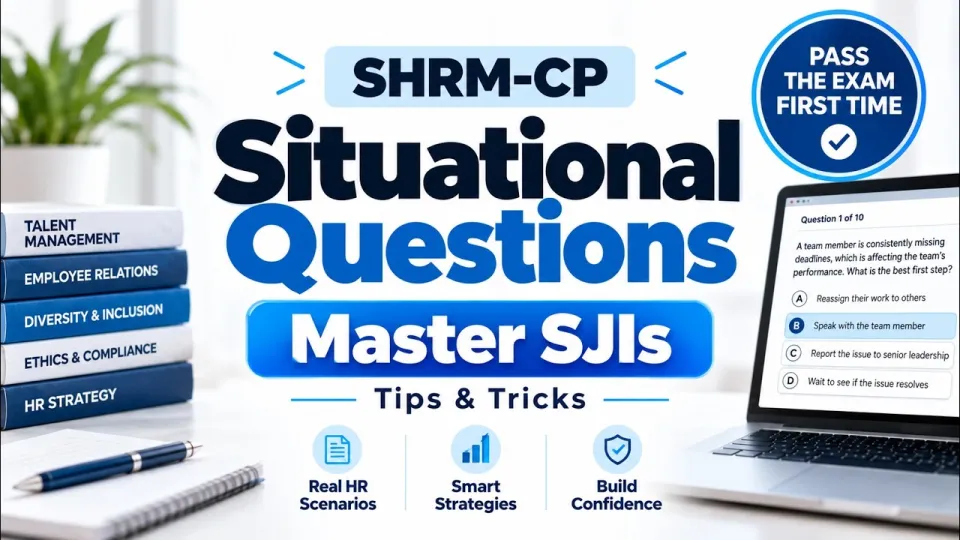
SHRM CP Situational Questions How to Choose the Best Answer and Avoid Common Traps
· based on the channel PrepSolution
SHRM CP situational questions can be challenging because all the provided answers often seem reasonable. To pick the best answer, it is essential to understand the difference between the immediate next step and the most effective action to resolve the issue comprehensively. The key is to apply a systematic method that evaluates each option against specific HR principles and scenario details.
One effective approach involves five decision checks: examining the facts of the case, considering relevant policies and legal requirements, determining appropriate escalation paths, assessing HR’s proper role, and identifying the right people who should be involved in the decision. By applying these filters, you can eliminate answers that may seem appealing but are flawed in context.
Understanding SHRM CP Situational Judgment Questions
Situational Judgment Items (SJIs) on the SHRM CP exam test your ability to handle real-world HR scenarios correctly. Unlike knowledge-based questions, SJIs require analyzing workplace situations and selecting the best course of action among several plausible options. The challenge is that multiple answers may appear correct at first glance, but only one aligns fully with HR best practices, legal compliance, and organizational policy.
The exam focuses on your judgment in applying HR competencies such as communication, employee relations, conflict resolution, and ethical decision-making. Success depends on distinguishing between actions that are simply acceptable and those that are most effective and appropriate.
Five Decision Checks to Evaluate Answers
When faced with SHRM CP situational questions, use these five decision checks:
- Facts: Confirm that the answer fits the specific details and context of the scenario. Avoid options that ignore or contradict key facts.
- Policy and Law: Ensure the answer complies with organizational policies and relevant legal requirements to avoid HR liability.
- Appropriate Escalation: Determine if the situation requires escalation and if so, whether the answer escalates properly without overreacting.
- HR’s Role: Recognize when HR should intervene versus when the manager or employee should handle the issue themselves.
- Involved People: Identify who needs to be part of the decision or resolution, including supervisors, employees, or legal counsel.
Applying these checks systematically helps eliminate answer traps and select the best response.
Common Answer Traps in SHRM CP Situational Questions
SHRM CP situational questions include several common traps that candidates must learn to recognize:
- Premature Action: Taking immediate disciplinary or corrective action without fully understanding the situation or gathering facts.
- Passive Responses: Avoiding the issue or failing to act when intervention is necessary.
- Taking Over Manager’s Responsibilities: HR should support and guide, not replace the manager’s role in handling employee matters.
- Unnecessary Escalation: Escalating issues too quickly or involving higher management when not warranted.
- Legally Defective Options: Choosing actions that risk violating employment laws or company policies.
Avoiding these traps requires careful reading of the question, applying decision checks, and focusing on HR’s strategic role.
First Step Versus Most Effective Action
One key to answering situational questions correctly is to clarify whether the question asks for the "next step" or the "best overall solution." Some questions require an immediate first action to stabilize a situation, while others want the option that resolves the problem most effectively even if it is not the initial step.
For example, if a supervisor requests employee discipline after a shouting match, the first step might be fact-finding or mediation rather than immediate discipline. The best overall action would address the root causes, ensure fairness, and maintain compliance.
Recognizing this distinction prevents choosing an answer that is correct in principle but does not meet the question’s intent.
Practical Tips for Eliminating Wrong Answers
When evaluating answer choices, do not rely solely on how your current or past workplaces handle situations, as practices vary widely. Instead:
- Test each answer against the scenario’s facts and wording precisely.
- Look for keywords or qualifiers in the question that indicate scope, timing, or role.
- Cross-check each option against the five decision checks.
- Eliminate options that violate policies, bypass appropriate channels, or ignore key stakeholders.
This methodical elimination is more reliable than guessing based on personal experience.
Useful Resources for SHRM CP Preparation
For further practice and detailed explanations, PrepSolution offers free SHRM CP practice questions that simulate the exam’s situational judgment format. These resources help reinforce the decision-making framework and familiarize candidates with common traps.
Free SHRM-CP Practice Questions
Итог
Choosing the best answer in SHRM CP situational questions requires a clear understanding of HR’s role, legal and policy compliance, and appropriate escalation. Applying the five decision checks—facts, policy and law, escalation, HR’s role, and involved people—helps identify the correct response while avoiding common traps such as premature action or unnecessary escalation. Distinguishing between the first step and the most effective solution is critical. PrepSolution’s detailed explanations and free practice questions provide valuable support for mastering these skills and succeeding on the exam.
Полезные ссылки
By practicing with these resources, you can confidently approach SHRM CP situational judgment questions and select the best answers.
Key takeaways
- SHRM CP situational questions require choosing the best, not just a good, answer
- Five decision checks guide the evaluation: facts, policy, escalation, HR's role, and involved people
- Common traps include premature action, passive response, and unnecessary escalation
- Distinguish between first step vs. most effective action in scenarios
- PrepSolution offers free SHRM CP practice questions for exam preparation
Source: SHRM CP Situational Questions (SJIs) | TIPS TO PICK THE RIGHT ANSWER · Markdown version
Questions & answers
What are SHRM CP situational questions testing?
SHRM CP situational questions test your ability to apply HR knowledge and judgment to real workplace scenarios, focusing on selecting the most appropriate and effective actions among several plausible options.
How can I distinguish between the first step and the best overall action in a situational question?
Carefully read the question to identify whether it asks for the immediate next step or the action that best resolves the problem. This distinction guides choosing either a stabilizing initial response or a comprehensive solution.
What are common traps to avoid in SHRM CP situational judgment questions?
Common traps include premature action, passive responses, taking over a manager’s responsibilities, unnecessary escalation, and legally defective options. Recognizing these helps eliminate incorrect answers.
Where can I find reliable practice questions for SHRM CP situational judgment items?
PrepSolution offers free SHRM CP practice questions and detailed explanations at https://prepsolution.com/free-practice/shrm-cp, providing valuable preparation materials aligned with the exam format.